This
World War I era political cartoon portrays the major European countries
involved in the foreground. Each of them, represented by people, are pointing
towards whomever they believe is the most responsible for causing the war. Most
countries are pointing at Germany as it was thought to be the main aggressor in
the war when it invaded neutral Belgium. The Allied powers showed this clearly
when they forced Germany to give up land and pay reparations when the war came
to an end with the Treaty of Versailles. However, what is in the background is
a large hand that represents other countries’ views on the situation, is
pointing towards an impaled body labeled “The Peace of Europe.” This shows how
others think the main problem of this war is that it has killed off the
peacefulness of Europe. The author’s choice to have that in the background
could represent how the finger pointing and naming of names being done by the
Allied and Central powers has overshadowed the real problem of peace, which is
why the countries are in the foreground. The crime of the ages is that the
peace in Europe died all on account of one assassination. The soon to be
Austria- Hungarian leader and his wife were killed by Serbians, which triggered
Austria- Hungary to take action, as well as Germany, Serbia, Russia, and
eventually many more. The tangling alliances and militarism brought the rest
into the war. The spider web of connections is shown in the pointing of hands.
Blame cannot be placed on only one country.
Sunday, December 21, 2014
Sunday, December 14, 2014
TOW #13 "Facebook Preventing Drunk Photos" (article)
In this
BuzzFeed article, the author talks about the topic of Facebook having a new
ability to tell the difference between a drunk picture of you and a sober
picture of you, and prevent the drunk ones from being uploaded. They had an
interview with the person that oversees the Facebook Artificial Intelligence
Research department, Yann LeCun. This qualified person explained how the
technology that would be in use is the same as the technology they use to
suggest things you might like. This technology is composed of deep learning
algorithms that will be able to decide whether you will regret the image you
are uploading the next morning. “’Imagine that you had an intelligent digital
assistant which would mediate your interaction with your friends,’ he says,
adding, ‘and also with content on Facebook.’” The upside is obvious. Imagine
how much embarrassment would be saved when you don’t have to worry about your
boss or family members seeing you absurdly drunk in pictures you uploaded on a
whim. There are many different kinds of people that would benefit from this.
The downside is, with a little added humor on the author’s part, would be that “after
the machines get so clever that there’s an inevitable robot uprising, there
probably won’t be any photos of you at all.”
Sunday, December 7, 2014
TOW #12 "Gunn's Golden Rules" (IRB- 1st half)
Tim Gunn wrote the novel, Gunn’s
Golden Rules: Life’s Little Lessons for Making It Work (with Ada Calhoun),
with a definite purpose in mind. From reading it, the message is quite clear.
In the book, Gunn takes you through moments in his life that changed his ways
of thinking. He explores positive moments as well as some negatives, hoping others
can learn from his own mistakes. A main component to the message is his view on
manners. “Good manners lead to better relationships, more career success, and
less personal stress.” (Gunn, 5). He then continues to portray the purpose of
his writing. Even with the multiple events he recalls, the point is never lost.
Each experience reflects his intentions on the reader learning from his
mistakes and moments, while being able to connect with some as well. The
author’s interpretation of things plays a great role in the book. Gunn’s
Golden Rules: Life’s Little Lessons for Making It Work is a non-fiction
book that is written from one point of view, so it is bound to have somewhat of
an opinion behind things. For example, Gunn talks about why he loves to receive
gift cards. “…they’re way better than crazy objects that I then have to move
around my house and hide in closets.” (Gunn, 105). Not everyone would agree
with that statement, showing that it is clearly his opinion about receiving
gifts. Other things that are of his own interpretation are his descriptions of
other people. Gunn loves fashion and can therefore describe a person’s outfit
accurately, along with his opinion on it. He is careful not to allow his
opinion to skew the visualization of the person, though. Since it is
autobiographical, there are plenty of opinions about things, situations, and
people he encounters.
Sunday, November 23, 2014
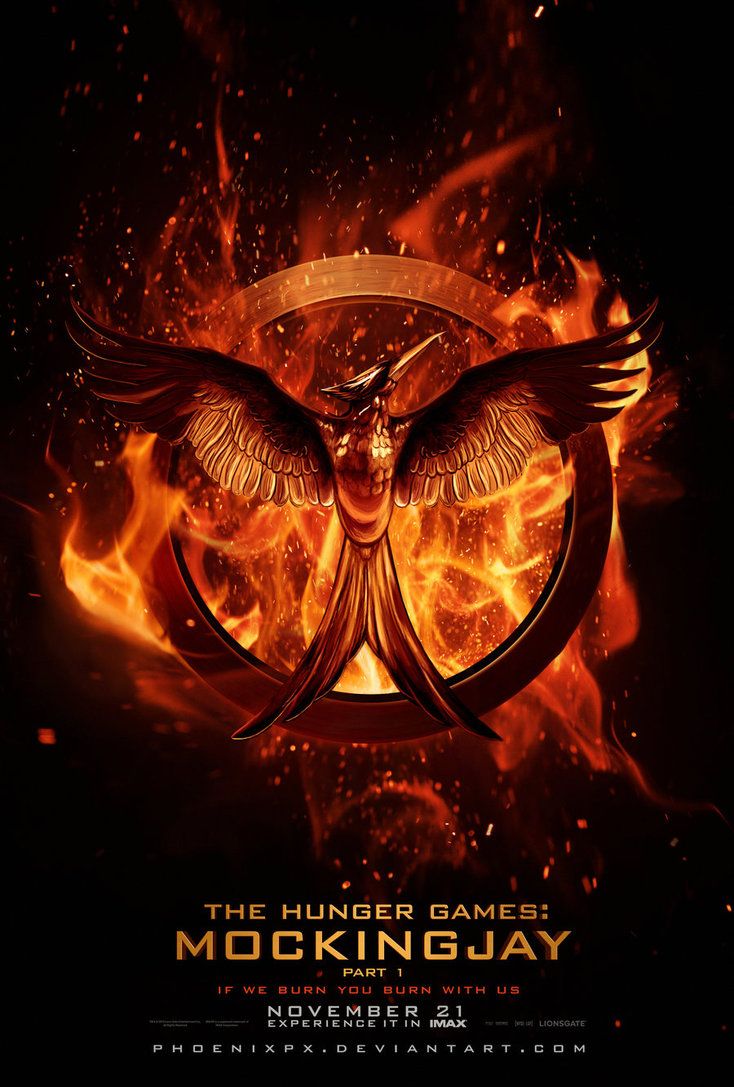
TOW #11 "Mockingjay- Part 1" (article)
In this
BuzzFeed article, Adam B. Vary talks about how low the debut of the newest
Hunger Games movie, Mockingjay: Part 1
is in relation to the other two movies. Outlining the claim with facts such as
the 22% drop in the price of Mockingjay from
Catching Fire. So far Mockingjay has made a total of about
$123 million, while Catching Fire had
made $158.1 million by this time last year. It is still the highest debut of
2014, but is a great deal less than the others. This grabs people’s attention
because so far the debut values have been rising for the series, then they
suddenly dropped. That is something unexpected. Most would expect the prices to
keep on rising like usual, but instead they plummeted. Though, it is still
quite impressive that it has only been a few days and Mockingjay: Part 1 has already made $123 million dollars in
American box offices. More numbers are then added to sugar coat the slight
disappointment. On the international stage, Mockingjay
is doing much better. In international box offices, the movie has made a total
of about $152 million this past weekend. So, that’s good news, right? Maybe if
it was not still lower than the others. Still below the first film’s $283.2
million and the second’s $440.2 million, the oddity still prevails. All of
these facts make a fan wonder why this newest movie is not selling as well, or
at least as quickly, as the rest. We’ll just have to see if this downward trend
will continue with the final movie, Mockingjay:
Part 2 that comes out in theaters November 20, 2015. Let’s hope we get some
answers to our question of why.
Sunday, November 16, 2014
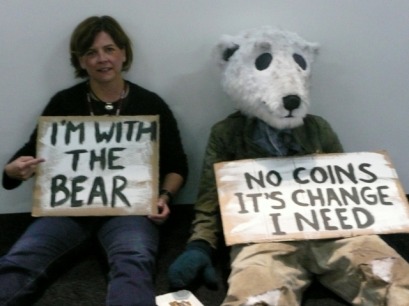
TOW #10 "No coins, it's change I need" (visual)
This
image shows two people protesting about global warming, and how it is affecting
polar bears. One of them is dressed as a homeless polar bear and holding a sign
that says “No coins, it’s change I need.” The play on words is a great way of
getting peoples’ attention because at first glance, one might think he is
contradicting himself, but in actuality, he is asking for change and not in the
way of ‘change’ being another word for currency. He wants the people and the
government to realize that the climate changing issue is a huge problem. He is
dressed homeless because the ice caps are melting causing many polar bears and
other wildlife to lose their homes. It would have a great impact on the
environment and society if this was allowed to continue and worsen. The woman
next to the man dressed as the bear, holds a sign that states “I’m with the
bear” and this shows that people are interested in changing what is causing
global warming and want to save the polar bears. It also can show that it does
not just affect the bears and life that relies on the cold weather and ice, but
it also affects people everywhere. People love polar bears. The thought of them
losing their homes makes people want to take action. Alongside that, anyone who
may not jump at the change to help the bears, would more than likely then take
action when they realize it affects them directly too.
Sunday, November 9, 2014
TOW #9 "I Hear America Singing" (poem)
I interpreted
the meaning of this poem to be something along the lines of: doing what you
love makes you strong, and it is something worth singing about. It is called I Hear America Singing because it is not
just specific people, it is the nation altogether. Each person has a different
job i.e. mechanics, carpenters, masons, boatmen, deckhands, shoemakers,
hatters, woodcutters, ploughboys, mothers, or girls, and Walt Whitman is
hearing them all singing. Since he includes a broad spectrum of professions, he
really is trying to include just about everyone in America. When saying what
each worker is doing while singing, it makes sense that they would do so,
therefore appealing to logos. Pathos is key, mainly in the last few lines of
the poem where he makes it clear that these songs are not sad or negative, but
that they are strong, melodious and proud songs being sung. The title is
obviously patriotic in the sense that he does not talk about the world singing
either, he talks about hearing the working people all over America singing. The
country is one unified nation with a unified voice that, at the same time, is
broken into individual voices singing equally strong and proud. This brought a
sense of power to the working class citizens who might have read this. It is
important for the people holding this nation together to be proud of what they
do, and continue making America as strong and proud as it can and will be.
Sunday, November 2, 2014
TOW #8 "Love is a Mix Tape" (IRB- 2nd half)
The
more I read of Love is a Mix Tape,
the more I realized it was less about Rob Sheffield’s time with his currently deceased
wife, Renée, and more about the music in his life in general. He tells stories
that helped shape who he is now. The music he had access to played a huge part,
and he is kind enough to tell us exactly what that music was. He uses his ethos
as a Rolling Stone editor and lover
of all things music to keep us readers interested in what song he will mention
next, and what it means to him. Sheffield definitely uses his own advice from
previous chapters about when and how to use a song at the right time. There are
few things more unsettling than a misused tune. He has, in his own way, created
a soundtrack to his own life. The amount of dedication he has to his love of
music is great itself and the book was a great reflection of that. The addition
of adding the list of songs at the beginning of each chapter, arranged in a way
that it looks as if they were taken directly from the back of his mix tapes,
added to the experience of learning about Sheffield’s life and the music in it.
Subscribe to:
Comments (Atom)
.gif)